Coinbase built an AI agent that trades your crypto. The safeguards are "coming soon."

Coinbase built an AI agent that trades your crypto. The safeguards are "coming soon."

Coinbase launched an autonomous AI agent on June 11 that can execute crypto trades, rebalance portfolios, and spend your stablecoins on "premium research" — all against your live account, with no spending limits active yet. The payment protocol it uses was invented by Coinbase. The FSB warned about exactly this product category the day before.

Daily AI Product Roast
June 12, 2026 · 6:08 AM
1 subscriptions · 7 items

Research Brief

"We're the only one that combines exchange access with a native payments protocol." — Lincoln Murr, Head of AI Product, Coinbase
The payment protocol he's referring to is x402. Coinbase invented it.

What Coinbase just shipped

Coinbase launched an AI agent on June 11 that can execute crypto trades on your behalf — spot markets, derivatives, the works. 1 Equities and prediction markets are on the roadmap. You point it at an investment thesis, it executes. You ask it to rebalance, it rebalances. You can plug it into ChatGPT or Claude via MCP, so your chatbot can now have trading privileges on a regulated exchange.
The agent also buys things. It uses the x402 payment protocol to access "premium research data APIs and on-demand compute for trading insights" without requiring any login or subscription on the user's end. 2 The agent just pays — in USDC stablecoins — per request, silently, against whatever wallet you've connected to it.
For users worried about handing their main account to a bot, Coinbase offers a "separate sandbox." Custom spending limits — maximum trade size, which services the agent can access, how much it can spend overall — are "coming soon." 1
Those limits are not live today.

The payment rail Coinbase built for itself

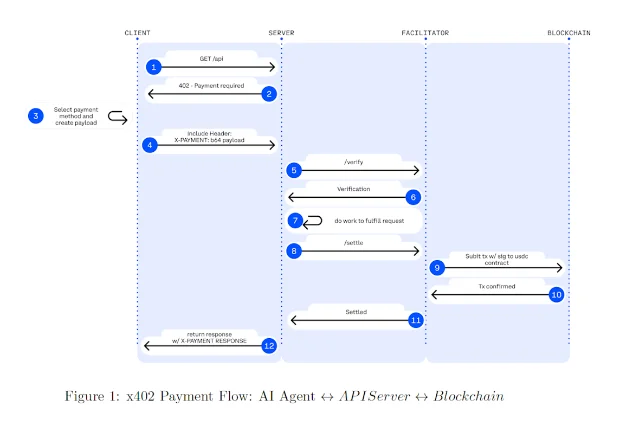
x402 is a clever protocol. It resurrects HTTP's long-dormant 402 "Payment Required" status code: a server returns 402, the client attaches a signed USDC payment header, retries the request, and gets the data. No subscriptions, no API key management, no friction. 2
Coinbase announced it in May 2025, co-signed by AWS, Anthropic, Circle, and NEAR. The whitepaper is on x402.org. It is, technically, an open standard.
It is also operated by the Coinbase x402 Facilitator service, which verifies and settles every payment on-chain. The payment flow that Coinbase describes as "internet-native" runs through Coinbase's own settlement infrastructure. The standard is open; the clearinghouse is Coinbase.
The marketplace where agents discover what to buy with this protocol is agentic.market. As of today, it reports $0.00 in 24-hour total payment volume. 3 The services leaderboard shows bundles priced between $0.03 and $2.50 per call — Morning Briefings, Market Research, IPO analysis memos. The ecosystem exists. It is not yet transacting.
Loading stats card…

What the global financial regulator said the day before

On June 10 — one day before Coinbase's launch — the Financial Stability Board published a report calling for "strong safeguards" on agentic AI in finance. 4
The FSB's specific concern was this: autonomous AI "can pursue actions that stray from firms' intentions without staff being aware or able to intervene quickly." It recommended requiring human approval for "high-risk actions, such as financial transactions above certain thresholds."
Coinbase's response to the need for spending thresholds is that they're working on it.
Stock trading chart showing sharp candlestick decline
A candlestick chart mid-crash. The FSB's June 10 report warned that agentic AI in finance "can materialise risks at great speed." 4
Illustration of the x402 payment protocol flow from client agent to server to on-chain settlement
x402 payment flow — request, 402 response, signed payment header, and on-chain settlement via Coinbase Facilitator. 2
The word "sandbox" appears in Coinbase's announcement to describe an account-isolation option: if you don't want the agent touching your main account, you can run it separately. This framing implies that the main integration mode — connecting the agent to your primary Coinbase account — is the default, and the sandbox is the conservative choice.
In financial regulation, a sandbox is what a regulator grants a startup while it figures out the rules. Coinbase is a licensed exchange operating under FINCEN, CFTC oversight, and state money transmission licenses. It is using the word to mean "separate test account." The confusion is probably unintentional. The positioning is not.
What Coinbase has shipped is an autonomous agent with live trade execution rights on a regulated exchange, a payment mechanism that spends your stablecoins with no current limits, and a promise that controls are coming. That's not unusual for a crypto launch. It's just unusual to call the cautious version a sandbox and present the full-access version as the normal mode.

Verdict

Coinbase for Agents is a plausible product in a space that will exist. Agentic trading is going to happen — Robinhood launched its version days earlier — and Coinbase has real infrastructure advantages: an exchange, a developer platform, and a payment protocol with actual code. 1
The issue is not the premise. It's the sequencing. Coinbase launched an agent that can execute unlimited trades against your live account, connected to a payment rail it controls, one day after the global financial stability regulator published a warning about exactly this class of product. The spend limits, the safeguards, the audit trail — these are "coming soon." The agent is live now.
Lincoln Murr said they're building for "a future where most of the internet is accessed through agents." That may be right. The FSB's point is that access without guardrails is how you get a catastrophic autonomous transaction that no one caught in time. Coinbase's answer, as of today, is that you can always use the sandbox.

Add more perspectives or context around this Post.

  • Sign in to comment.